
Our displays
Deeper dive
Two claims stand on the home page without their evidence. Here is the evidence — the angular argument against a flat surface, and how coverage is specified from the mission rather than fixed by the product.
Uniform resolution everywhere the eye lands
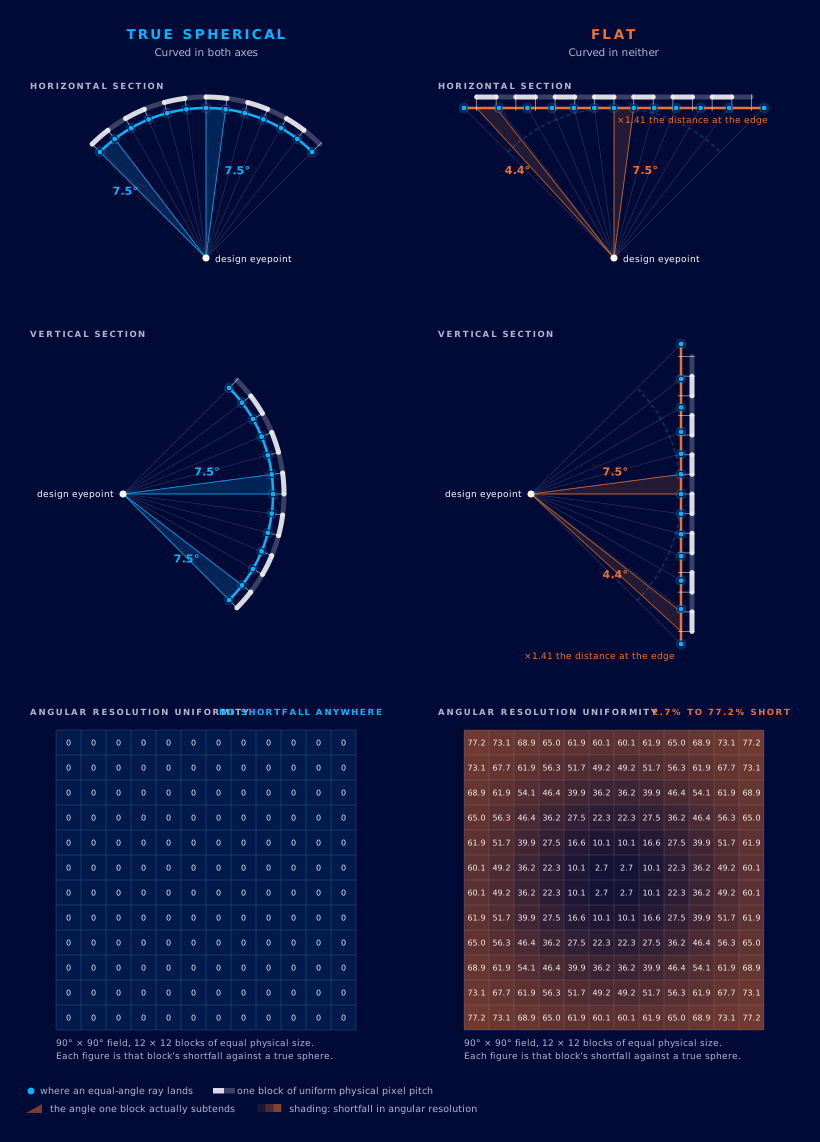
Fig 1 — Angular resolution uniformity, spherical against flat. Sections through the design eyepoint in plan and in elevation, and each surface divided into a 12 × 12 grid of blocks of equal physical size across a 90° × 90° field.
The angle a block of surface fills is calculated using the distance from the eyepoint and combined with how far its surface normal leans from the line of sight. On a sphere centered on the design eyepoint, every pixel is oriented toward the eyepoint. On a flat surface, only a small cluster of pixels are directly oriented at the eyepoint.
A large flat display creates its own angular distortion. That limits the usable field, and limits the size and scale of data visualization. The alternative is multiple smaller flat displays that facet the room — a scattered approach that bounds the scale of the data presented and stands in the way of a comprehensive picture.
How the geometric boundaries are specified
Horizontal coverage and vertical extent are two numbers, and they do not move together. More coverage is not automatically better. The right answer follows the mission.
- Simulation and training — 180° to 330° horizontal. The immersion band. Threats and traffic need somewhere to come from, and peripheral motion carries real information. Below 180° the world has an edge the trainee can see; above 330° the remaining gap is behind them and often not worth its cost.
- Command, control and data visualization — frequently 180° or less. Coverage follows the number of operators and the volume of content to be displayed. Spread too little content across too much surface and the picture thins out, head movement goes up, and information ends up behind people instead of in front of them. Several of the strongest configurations sit well under 180°.
- Uplook — a closed or toric top, where the content genuinely is overhead. Counter-UAS and overhead threat engagement, flight and space operations with look-up, astronomy and all-sky work. This is where a closed configuration earns its access structure and clear-height requirement.
- Look-down — specified as a viewshed rather than an angle. Air traffic control needs the runways and aprons out from the cab, not the ground underfoot, which is why a tower configuration is 360° horizontal with no closed top at all. Paying for an overhead surface there buys nothing the mission uses.
The truncation is an operational advantage
In most configurations the sphere is cut at the floor and capped below full height. That truncation is what makes the product architecturally deployable. It preserves ground-level walk-in access, egress paths, air distribution, service access and ceiling-height code compliance — and it is what allows people, consoles, mockups and real equipment to be placed inside the volume. Each of those is a requirement in a real building.
A full 360° configuration trades exactly those advantages for complete coverage, which is why it carries a lift or staircase, its own egress and accessibility provisions, and a taller clear height. It is the right answer for some missions and an expensive answer for most, and the budget impact is worth understanding early.
Heat, air and acoustics belong in the conversation early, and they are ordinary mechanical engineering rather than obstacles. A large LED surface carries a real heat load, and that load is set by the display rather than by the geometry. The truncated configurations help on the mechanical side, because an open floor edge and an open top permit conventional air distribution rather than the dedicated plenum a fully enclosed volume requires. Where voice communication is the mission — tower cabs, watch floors, teleoperation stations — background noise level should be stated as a requirement at the start, alongside the thermal load.
Coverage in every axis is a price and siting decision, not a property of the product. No application should be ruled out for an assumed gap behind or above the viewer, and none should be over-specified either.